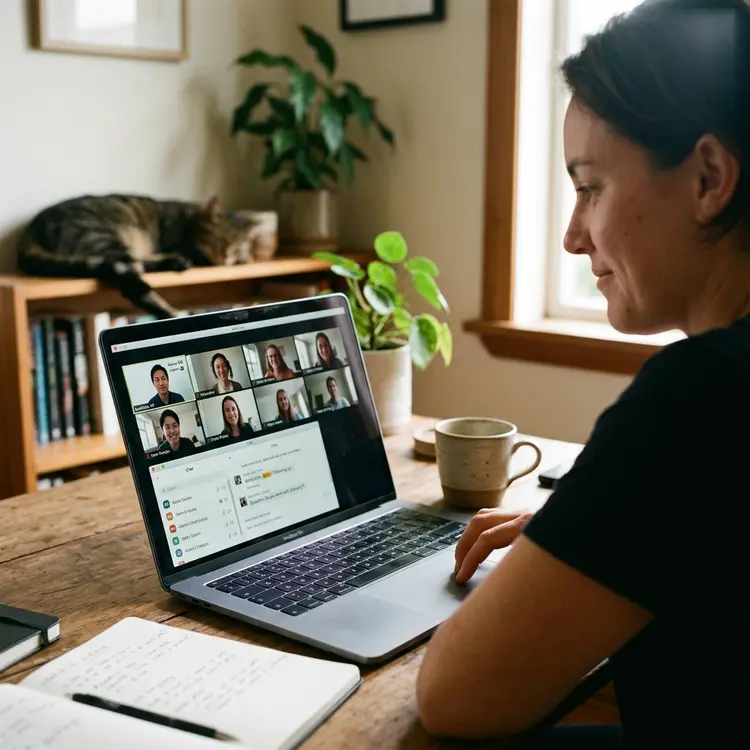
TL;DR: Online networking builds trust and generates referrals as effectively as in-person meetings, often faster. Consistent weekly attendance on Zoom creates accountability, visibility, and measurable results. The digital format offers advantages such as recorded meetings, timestamped commitments, and opportunities for content creation.
What you need to know:
Weekly online meetings build deeper connections than sporadic in-person networking
Digital accountability (chat logs, recordings, timestamps) increases follow-through on referrals
BNI members generated $12.8 billion USD through 8.7 million referrals in H1 2025
Online format removes geographical barriers and saves time on travel
Successful members vary their weekly pitch and actively engage through chat
What Makes Online Networking Work?
People think you don’t build real trust through a screen.
They’re wrong.
I’m a member of BNI Breaking Boundaries, an online business networking chapter in New Zealand. What I’ve seen tells a different story.
People who show up consistently every week on Zoom build deeper connections faster than those who engage in sporadic in-person networking.
Why Online Meetings Feel More Authentic
You see people in their home offices. Kids pop in sometimes. Dogs bark.
There’s an authenticity you don’t get in a conference room where everyone performs their professional persona.
Here’s the big difference: you’re visible the entire time.
In a physical room, you stand at the back, check your phone and chat while someone presents.
Online? You’re in gallery view. Everyone sees if you’re checked out.
When you give your 60-second pitch, you’re front and centre. Nowhere to hide.
The chat function means people can respond in real time. Drop comments. Ask questions.
Passive attendance doesn’t work. You’re either present and participating, or everyone knows you’re not.
The bottom line: Online format forces genuine engagement because visibility creates accountability.
How Does Commitment Show Up Online?
Distance Becomes Proof of Seriousness
Our members are spread across New Zealand. One lives in Japan.
When the Japan-based member logs in (brutal time difference), everyone notices.
Clear message: this isn’t casual networking. This is a business investment.
People who consistently show up with a camera on, pitch prepared, actively listening to others… they build credibility fast.
The group thinks:
If they’re this committed to the chapter, they’ll be this committed to any referral I send them.
Distance becomes proof of reliability. That’s when referrals start flowing.
Research confirms reliability is the single most important factor in virtual team trust. 89% of team members cite it as essential.
What this means: Showing up consistently online builds trust faster than occasional in-person meetings.
How Do Referrals Happen on Zoom?
A Real Example: Mortgage Adviser Meets Property Manager
A few months back, one of our members (a mortgage adviser) mentioned during the 60-second pitch that she wanted referrals to first-time buyers struggling with the process.
The property manager jumped into the chat immediately after. She had three tenants asking about buying.
They set up a Zoom call that week. The mortgage adviser worked with two of those three tenants. The entire deal was closed online.
Pre-pandemic, people insisted on face-to-face for something as big as a mortgage.
Now? Happens on Zoom. Faster too, because there’s no travel time, no scheduling around office hours.
The property manager told me later she wouldn’t have made the connection at a traditional event. Probably wouldn’t have remembered the mortgage adviser’s specific focus.
But hearing it weekly, seeing her on screen… it stuck.
BNI members generated over $12.8 billion USD through more than 8.7 million referrals in the first half of 2025 alone.
The takeaway: Weekly repetition combined with visual presence makes you memorable when opportunities arise.
Does Weekly Repetition Get Boring?
How to Keep Your Pitch Fresh
You’d think hearing the same pitch every week gets boring.
It does, if people repeat the exact same script word-for-word.
Members who get the most referrals vary their pitch based on what they’re working on that week.
Mortgage adviser says one week:
I’m looking for first-time buyers.
Next week:
I’ve got a client who needs a bridging loan.
Same core service. Different specific ask.
Keeps people listening because they think:
That’s different from last week. Do I know someone who fits that?
Structure creates familiarity. Content stays fresh.
Plus, online lets people go back through chat history or recordings if they need something specific. In a physical room, miss the detail, and it’s gone.
The strategy: Keep your core message consistent, but adjust your specific ask to current needs.
What Are the Hidden Advantages of Online Networking?
Digital Accountability Works Better
Accountability is stronger online.
In physical meetings, you say you’ll follow up with someone. It’s your word against theirs.
Online? Everything’s timestamped in the chat.
Someone says, “I’ll introduce you to my accountant”.
Right there in writing.
People follow through more because there’s a digital trail.
Bringing Visitors Is Easier
The barrier to bringing visitors is lower, too.
I tell a potential member: ‘Click this link at 7 am on Friday.”.
They’re in.
We’ve had visitors from Auckland, Wellington, Christchurch and even Australia. They’d never attend an in-person chapter because of geography.
The recording function means that if you’re sick or have an emergency, you can catch up on what you missed. You don’t lose that week’s connections.
Every Meeting Becomes Content
I handle social media for our chapter. I record meetings and repurpose the 60-second presentations and 10-minute features for our website and social channels.
Every member becomes a content creator.
Once people know their pitch might be clipped and posted on LinkedIn, they tighten up their messaging.
They’re more conscious about being clear and professional. Not 30 people hearing it… potentially hundreds online.
Some members get enquiries directly from those social media clips. People, not even in BNI, see the video and reach out.
A tradie who’d never make a promotional video? Has one now because they did their feature presentation well.
The advantage: Online networking doubles as marketing when meetings are recorded and shared.
What Do Visitors Say About Online Chapters?
First Impressions from Sceptical Visitors
Visitors from traditional in-person chapters come in thinking online will be watered down.
Then they see the engagement level. Chat activity. Content is being created.
They realise it’s more professional in some ways.
I’ve heard from people in Australia whose local chapter meets in a café or pub. Casual, which is fine. But there’s no record of what happened. No content generated. No way to revisit conversations.
They see what we’re doing and think:
I’m getting more value here as a visitor than as a member of my own chapter.
Some switch to Breaking Boundaries permanently. Online format fits their lifestyle better. They see the return on investment more clearly.
Data shows 88% of participants report virtual networking saves them considerable money. 76% value the flexibility in location and time.
What visitors notice: Online chapters often deliver more measurable value than casual in-person meetings.
How Quickly Can You Tell Who’ll Succeed Online?
The Three-Week Filter
You’ll know within three to four weeks if someone’s going to make it.
Signs someone won’t stick:
Camera off more than once without a good reason
Not using the chat
Pitch sounds like they’re reading from an unchanged script
Not staying for networking after the formal meeting ends
Biggest tell? Follow through on commitments.
Someone says in week two, they’ll make an introduction. By week four, it hasn’t happened. That’s a pattern.
Online, it’s in the chat history. No excuse for forgetting.
Members who thrive? By week three, they’re already referring, commenting in chat on other pitches, and showing up with energy.
Case Study: From Visitor to Top Referrer in One Month
One visitor became a top referrer fast.
First meeting: in the chat, asking questions, stayed for the full networking session, set up one-to-ones with three members by the end of week one.
They came prepared with specific questions about each person’s business.
In one-to-ones, they’d say: “I noticed in your pitch that you work with hospitality clients. What’s the biggest challenge they’re facing right now?”
They listened to understand how to refer.
Within a month, they’d done one-to-ones with almost everyone. Already passed three solid referrals.
The Internet made that easier. Scheduling one-to-ones means sending a Calendly link. No coordinating coffee shops or travel. Three one-to-ones in a day is easy, back-to-back on Zoom.
Success pattern: Proactive engagement plus intentional listening equals fast relationship building.
What Do Sceptics Misunderstand About Online Networking?
Format vs Relationship: The Core Confusion
The fundamental misunderstanding is that people think the format is the relationship.
It’s the container.
Relationships aren’t built by proximity. They’re built by consistency, follow-through, and genuine interest in helping each other.
I sit next to someone at 10 different networking events and never build a real relationship unless I’m paying attention and following up.
Or I meet someone on Zoom every week for three months, have meaningful conversations, send quality referrals, and build something solid.
Real networking doesn’t require physical presence. It requires intentional presence.
Online forces you to be intentional. You don’t rely on the social lubrication of a shared meal to carry on a conversation. You engage.
For business owners serious about results (not feelings about networking), intentionality matters more than another breakfast where half the room’s on their phones.
Sceptics measure physical presence. Should measure commitment, follow-through, and business generated.
By those metrics, online networking isn’t as effective as in-person networking. It’s often better because it strips away the theatre and forces substance.
The truth: Intentional online engagement beats passive in-person attendance every time.
Should You Wait for Normal to Return?
Why Waiting Means Losing Ground
If you’re avoiding online networking because you’re waiting for things to get back to normal, you’re waiting for a version of normal that doesn’t exist.
Business owners who adapted three years ago aren’t going back. They’ve seen that it works better for how they operate.
They attend a 7 am meeting without losing two hours to travel and small talk. Do three one-to-ones in an afternoon instead of one per week. Build a national or international network instead of being limited by driving distance.
“Getting back to normal” assumes in-person is superior.
What I’ve seen: it’s different. In many ways less efficient.
Business owners still waiting operate on nostalgia.
Meanwhile, people who embraced online networking spent the last few years building relationships, generating referrals, and creating content working for them 24/7.
You don’t get that time back.
Even chapters that went back to in-person keep hybrid options. Members don’t want to give up the flexibility and reach of online.
We Still Meet Face-to-Face Sometimes
We meet in person occasionally.
Last week, BNI New Zealand ran a conference in Christchurch. We had up to 22 members at an in-person lunch. For a 30-person chapter with members spread across the country (and one in Japan, who was at the lunch), that’s solid.
But the foundation is online. That’s where consistent work happens.
The question isn’t whether online networking works.
It’s whether you’re willing to adapt to where business relationships are happening now.
Frequently Asked Questions
How long does it take to get referrals from online networking?
Most active members start receiving referrals within 3-4 weeks. The key is consistent attendance, varied weekly pitches, and doing one-to-one meetings with other members early on.
Do I need special equipment for online networking?
No. A computer or tablet with a webcam, a microphone, and a stable internet connection is enough. Keep your camera on and find a quiet space with decent lighting.
How is online networking different from LinkedIn networking?
Online networking through structured chapters like BNI involves live, scheduled weekly meetings with the same group. This builds deeper relationships than asynchronous interactions on LinkedIn. You’re committing to show up consistently, not sending occasional messages.
Won’t people forget about me if we only meet online?
The opposite happens. Weekly video meetings with active chat participation make you more memorable than occasional in-person events. Plus, recorded meetings and social media clips extend your visibility beyond the meeting time.
What’s the time commitment for online business networking?
Plan 90 minutes weekly for the main meeting, plus time for one-to-one Zoom calls with members (typically 2-3 per month, 30 minutes each). The lack of travel time means online networking takes less total time than in-person.
How do I know if someone’s serious about referring to me online?
Check the chat history. Serious members follow through on commitments made in chat, actively comment on others’ pitches, and schedule one-to-ones quickly. You’ll see patterns within 3-4 weeks.
Does online networking work for all types of businesses?
Works well for service-based businesses and consultants. Physical product businesses benefit too, though you’ll need clear ways to demonstrate what you do, such as screen sharing or samples shown on camera.
What if I’m not comfortable on camera?
You’ll adapt faster than you think. The format requires camera-on participation, which becomes natural after 2-3 meetings. Members who struggle with this usually aren’t a good fit for structured online networking.
Key Takeaways
Online networking builds trust through consistency and accountability, not physical proximity
Weekly video meetings with chat engagement create deeper connections than sporadic in-person events
Digital trails (timestamps, recordings, chat logs) increase follow-through on referrals and commitments
Members who succeed online vary their weekly pitch, do one-to-ones early, and actively use chat features
Recording meetings creates marketing content and extends reach beyond the immediate group
Geography stops being a barrier, opening national and international networking opportunities
Success shows up within 3-4 weeks through active participation, not passive attendance
If you’re a business owner in New Zealand looking for structured networking that delivers measurable results, BNI Breaking Boundaries meets every Friday at 7 am NZ time on Zoom. Visitors welcome. Be ready to participate.